
Return to Play… how to safely rehab your horse!
INTRODUCTION
Returning to ridden work can be a daunting experience, particularly if your horse is rehabbing from an injury. But whether you are looking to bring your horse back from their winter holiday or rehabilitate them from a ligament injury, this is all the information you need to start! Before planning any sessions, take a step back and consider:
Your horse’s age, weight, ridden discipline and workload history
Any existing health conditions or injuries- the pathway to recovery looks different for every case
Your horse’s daily routine (are they stable or field kept?) and time spent moving
Your short and long term riding goals
It is worth writing your plan and goals down, whilst also utilising your wider team (for instance your instructor, vet or physio) for support and guidance- you don’t have to do it alone! There are also online programmes or other sources of information which may offer you some further guidance, such as the British Horse Society.
WHERE TO START?
It’s important to begin at a level that your horse can manage. For any horse, when first returning to ridden work it is important to optimise:
1. Low intensity work (walk work or in-hand exercises are often a safe place to start- with safe being the key word!)
With a short duration (start with 15-minute sessions and include short breaks)
Using a low frequency (roughly 4 sessions per week)
Your horse’s behaviour is your best form of guidance during these initial stages- are they relaxed and happy to engage, or showing signs of resistance or discomfort? If you aren’t sure what signs to look out for, it is worth studying Sue Dyson’s Ridden Horse Pain Ethogram- in which a horse who displays more than 8 of the 24 behaviours (shown in the diagram below) may have hidden musculoskeletal pain. You should also keep an eye out for:
Unusual behavioural changes (such as tail swishing or resistance)
Physiological signs (elevated heart rate, respiratory rate or temperature at rest post exercise)
Reluctance to eat or signs of discomfort (such as kicking at stomach) after exercise
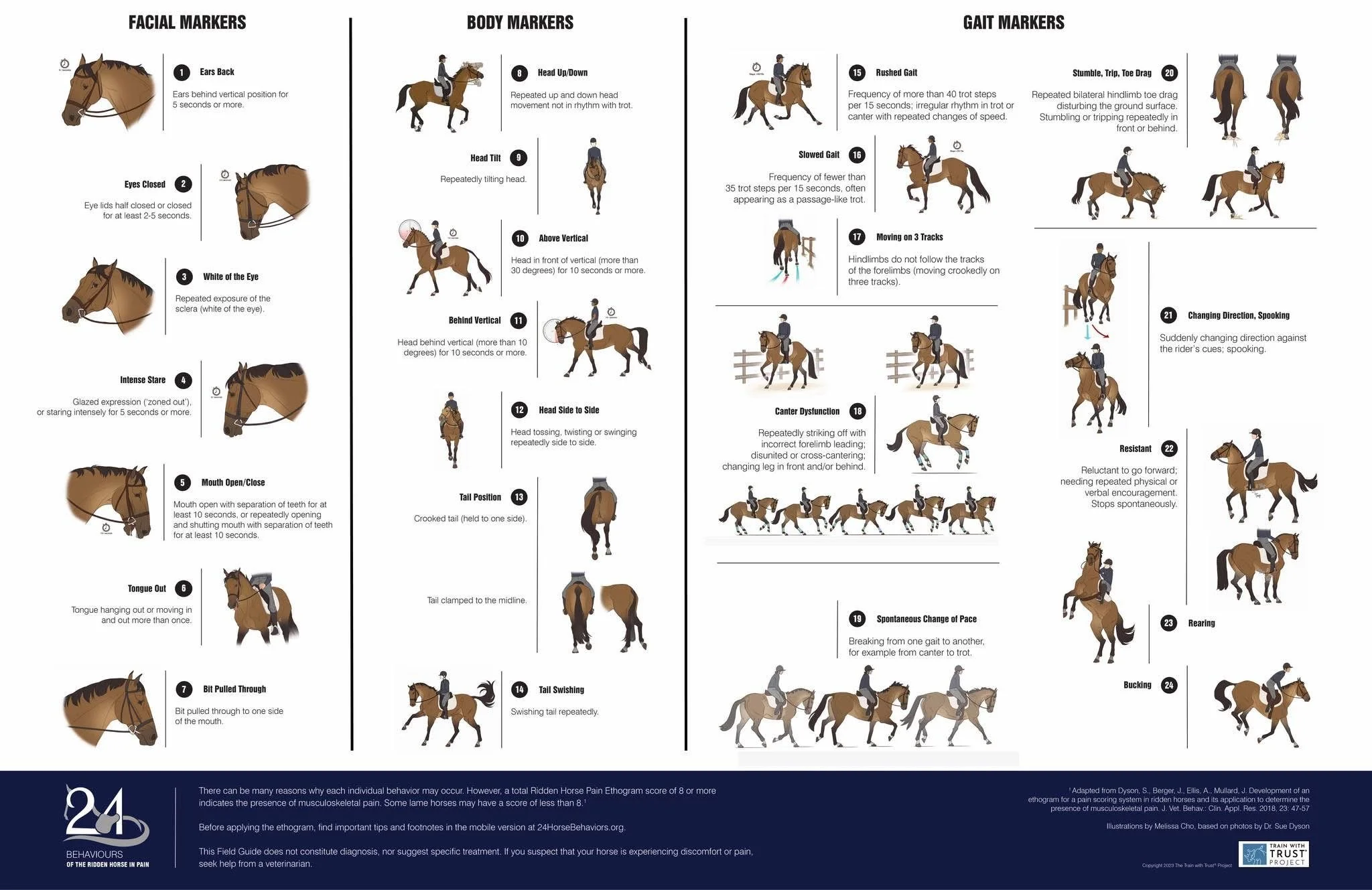
| Image Reference: A visual representation of the Ridden Horse Pain Ethogram (Sue Dyson); Melissa Cho (2023) |
WHAT KIND OF EXERCISES CAN I DO?
Exercise should be introduced gradually in the first few weeks to months. Recommended forms of exercise throughout this process- as approved by your vet- should include:
Hillwork: A great form of exercise to build up muscle tone and develop balance. Can be completed both uphill and downhill.
Roadwork: Great for low-impact aerobic conditioning when in a safe environment.
Polework: Raised poles or cavaletti, using different patterns such as slalom or fan shape.
Interval training: walk-trot-canter exercise with timed interval breaks to restore resting heart rate.

These can all be completed either ridden or in-hand, depending on what’s safest for your horse. Make sure though to have your vet’s approval before making any changes, increase the level exercise gradually, keep routines consistent and manageable and watch for early signs of pain, such as changes in gait, reluctance to move, or behavioural shifts. It is important with any horse to make a gradual return to activity- make a long term plan with gradual increases in duration and frequency of work. If your horse has a history of health conditions, then make sure that you are extra careful when looking for signs of pain or discomfort during exercise. For the best workout, try to use a combination of:
Aerobic exercises to support fat loss
Strengthening exercises to build muscle and posture
Stable exercises like carrot stretches and tail pulls- and even alternative therapies like water treadmills- can be great additions to your plan. Just make sure to tailor training aids to your individual horse, and always ask a professional for guidance (this is a great opportunity to utilise your veterinary physiotherapist for relevant exercises!).
| “Raised Poles” image shows an example of raised poles in a fan position, completed in hand in walk |
HOW TO STAY CONSISTENT?
Gradual progression of exercise is crucial to minimise risk of injury for overweight horses, due to the amount of load being placed on the limbs- did you know that 60% of the horse’s weight is placed over its forelimb, and 40% over the hindlimb?
Consistency is crucial- but so is variety. To stay motivated:
Write a simple weekly plan with short-term goals
Use habit stacking (for example, adding 5 minutes of poles after your usual grooming session)
Mix it up; don’t do the same activity two days in a row
Aim to start with a 15 minutes routine twice a week, then build up gradually. Don’t forget to schedule rest days for both you and your horse. For instance, you could plan to hack on the road in walk on a Monday, then do polework in the arena on a Tuesday.
FINAL THOUGHTS…
There’s no “one-size-fits-all” approach to exercise. But with careful planning, support from your team, and a bit of patience, you can make safe, sustainable progress. The bonus? You’ll be improving fitness, strength, and overall wellbeing together. Habit stacking is a great way to rehabilitate your horse as part of your usual routine. If you already do 15 minutes of schooling on a Tuesday, can you incorporate a new in-hand exercise at the end of your session, such as raised poles? Try to build up your routine gradually and don’t feel that you have to add everything in at once! But most of all, make sure that your routine is both enjoyable and fulfilling for both you and your horse.
USEFUL RESOURCES…
1. Sue Dyson’s Ridden Horse Pain Ethogram
(https://beva.onlinelibrary.wiley.com/doi/epdf/10.1111/eve.13468)
2. British Horse Society Horse Fitness
(https://www.bhs.org.uk/horse-care-and-welfare/health-care-management/horse-health/horse-fitness/)
3. British Horse Society Implementing a Fitness Programme