
INTRODUCTION
In this modern age of the “health and fitness obsession”, there are certainly benefits and drawbacks. However, it is encouraging that there is a growing understanding of the many complexities of horse rider fitness. Horse riders are finally realising that they are ATHLETES. Whether you ride one horse recreationally at a riding centre once a week, or multiple horses every day at elite competition level, it is your responsibility to look after your health and wellbeing to the best of your ability as a sign of respect to both your horse and yourself. Of course, this looks different for everyone, we can’t all be elite level athletes! But even the smallest of changes will have your horse thanking you for it.
BUT WHERE TO START?
You may be asking, it’s all very well expecting me to become fitter and healthier for my horse but it’s a minefield out there! And this is of course very true. There are so many online resources these days, including many social media accounts which may or may not be offering legitimate advice. This is where I think it’s better to invest if you can and seek professional advice. Whether that is a physiotherapist, a personal trainer, a nutritionist… the list goes on. Just make sure that your chosen professional has the relevant qualifications, for example a chartered physiotherapist should always be searchable on the HCPC website.
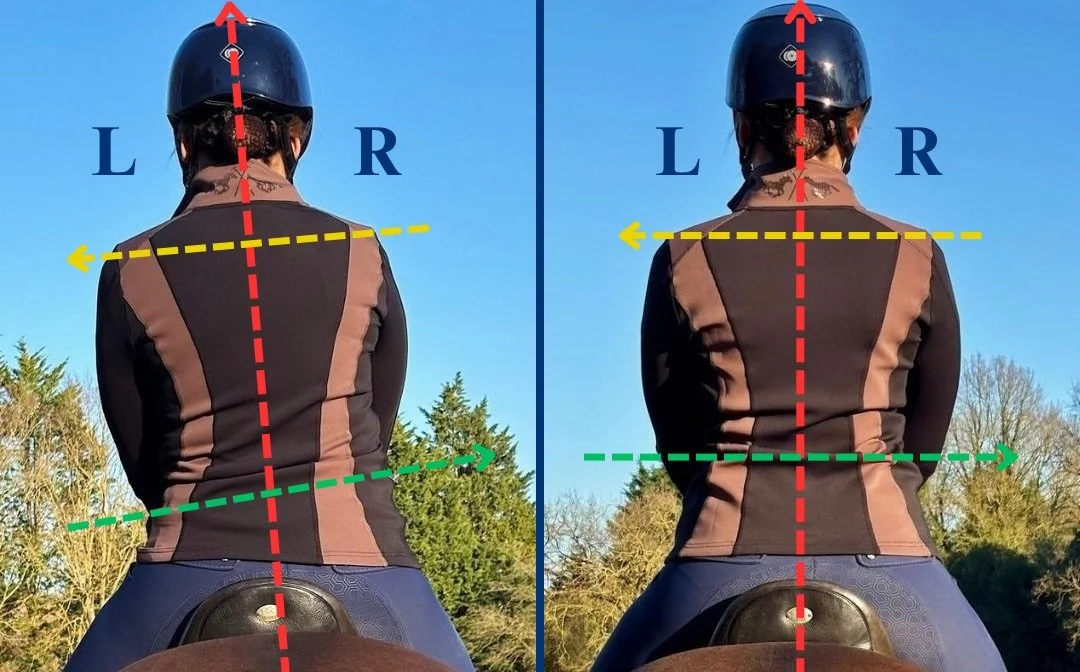
As a physiotherapist, I can take a subjective history from you, objectively assess you and make a treatment plan alongside you. As part of my horse rider assessments, whether that’s in clinic or at your house/yard, I will complete a full biomechanical assessment from head to toe to figure out “where your body is in space”, then I will ask you to complete a series of “tasks” to assess what your body does in each movement. For example, in standing you may have a small pelvic torsion to the right (stay with me here) but when you squat down- mimicking the riding position- your pelvis may increase into the right torsion and affect the way your hip flexes, your ankle flexes, your ribcage rotates… you get the picture. All of these biomechanical imbalances will have an impact on your horse and their biomechanics. Even better if I can either see you on your horse or watch a few videos- then we can get an idea of the relationship between you, your horse and even the saddle.
I may also refer you on to other relevant resources or professionals. It may be that you would benefit from an 8 week strength and conditioning programme guided by a PT. It may be that you need regular sports massage therapy to release stubborn areas of muscle tension. You might need some support from a nutritionist to plan your meals each week. Sharing is caring! And the multidisciplinary approach is in my opinion the best way to optimise your health; there is not one path alone to success.
HOW CAN I IMPROVE MY PHYSICAL HEALTH?
I often like to break down physical health into the following categories:
→ Cardiovascular fitness
→ Mobility and flexibility
→ Strength and power
→ Balance, stability and control
→ Nutrition
→ Recovery and sleep quality
One observation I often hear as a physiotherapist is “I simply don’t have time to fit all of that into my schedule… I have a household, a horse and a career to run!”. This is one of my favourite parts of my job- how do we solve the puzzle of time... I believe that there are always ways of adapting a routine to fit all of the puzzle pieces into the finished picture. For example, can you stand on one leg whilst brushing your teeth at night? Do you already lift multiple buckets and haynets every day? Can you meal prep healthy options for the week? Can you reduce screen time to fall asleep earlier? All such simple options, but when combined these can help you on the successful path to health.
When thinking about equestrian health and fitness specifically, the way we train may also differ between each equestrian discipline. When broken down, the fundamental basics are the same, but there are certainly specific demands for each one, particularly at elite competition level:
-
Dressage Riders need good pelvic stability, including glute and hip flexor strength in order to absorb the movement of the horse. Core strength and trunk mobility are also crucial during lateral movements. I often recommend specific Pilates exercises to dressage riders, as this is a great way to improve balance, stability and control without losing mobility and flexibility. Pilates is also crucial to improve breathwork, with an emphasis on diaphragmatic breathing.
-
Showjumpers need to have the reactivity and power required to react to the demands of a fast jump off and a powerful horse. For showjumpers I suggest a mixture of cardiovascular exercise and strength and conditioning focusing on plyometrics (explosive exercises). Again, core strength and trunk mobility are crucial but in this instance for those tight jump off turns and power absorption during the five stages of jumping- approach, take off, moment of suspension, landing and getaway.
-
Event Riders need all of the above, plus endurance. My event riders will likely be doing a combination of Pilates, strength and conditioning and cardiovascular exercise but with a focus on building muscular stamina- high reps over power. Not dissimilar to their horses, I would expect an event rider to have at least a basic understanding of their VO2 max and heart rate zones when training.
-
Racing Jockeys need to have isometric stamina (muscle strength which can be sustained in one position). Think wall sit for an hour or so. The differences for these riders will depend on whether they are a flat jockey or National Hunt, which will require the physical demands similar to a showjumper- ability to absorb impact over fences and react quickly, which takes us back to plyometrics. Racing jockeys, as with event riders, will also need an understanding of their VO2 max and heart rate zones.
-
Polo Players need strong pelvic and core stability (predominantly lateral core) and trunk mobility to withhold the demands of a strong swing whilst travelling at high speed in a saddle with no knee roll. The polo mallet is essentially an extension of their right arm, and they must have the upper body strength required to create a powerful hit. I would advise any polo players to work on a tailored strength and conditioning programme which works on these aspects – Pallof press is a great exercise for example.
… I could go on, as there are so many other equestrian disciplines to cover, but I’ll stick with these for now. Feel free to contact me if you would like to learn more about the demands of your specific discipline!
WHAT DOES THE RESEARCH SAY?
Oh I do love this part. Even better, there is new research to support rider fitness! A study published this year has looked at the influence of rider physical activity on improving seat balance in the context of horse welfare (Zeliszewska-Duk et al., 2026). They split a cohort of 20 horses amongst a control group of 10 riders who completed dressage sessions every other day, and an experimental group of 10 riders who completed dressage sessions every other day, as well as the following programme three times weekly:
Plank: To strengthen core muscles and for spinal/pelvic stability
Squats: To strengthen quad and glute muscles and to improve balance and stability
Deadlift: To strengthen the back, glutes and quad muscles and to improve strength and stability
Dumbbell rowing: To strengthen the back and arm muscles and improve posture
Exercises on a yoga ball: To improve balance and activate deep core muscles
Stretching: To improve flexibility and range of motion
Pressure changes measured underneath the saddle showed that there was greater instability, and therefore asymmetry, in the control group by the end of the study. This would suggest that there were greater unbalanced forces acting on the horse’s back, which could lead to increased muscular asymmetry and defined areas of tension through the equine spine. This study has shown that the above exercise programme performed three times weekly can greatly improve stability and symmetry when riding flatwork.
Clayton et al. (2023) offer a great summary of the effect of the rider on the horse, using biomechanical principles. They suggest that there is a general consensus that rider weight does not affect the horse’s gait pattern until it exceeds 20-25% of the horse’s weight, although this may be dependent on breed. They also consider rider saddle interaction to be very important and extensive research is still ongoing in this area- watch this space! Rider asymmetry has already been recorded to increase asymmetrical saddle forces on the equine back (Gunst et al., 2019), not dissimilar to the 2026 study results above. One quote from Clayton et al. (2023) really stood out to me:
“The challenge in neuromotor control is to maintain a coordination pattern that resonates with the horse”
The British Horse Society (2022) recommend that horse riders should consider their cardiovascular fitness, core strength and flexibility- they also remind us to remember to warm up as well as our horses! The National Health Society (2024) outlines guidelines for adults aged 19-64 years old, including those who are disabled, pregnant or new mothers- although I firmly believe that this should be carried out under strict professional guidance. They state that adults should do at least some type of physical activity every day, suggesting to do:
→ Strengthening activities that work all of the major muscle groups where possible (legs, hips, back, abdomen, chest, shoulders and arms) at least 2 days a week
→ 150 minutes of moderate intensity activity a week, or 75 minutes of vigorous intensity activity a week
TO CONCLUDE
There is certainly “no one size fits all” approach to horse rider fitness, as there are so many variabilities to consider. But the research tells us that it is our responsibility to understand our biomechanical relationship with the horse in order to reduce asymmetry and therefore improve horse welfare. As I have said before, utilise the team around you! There are many pieces to the puzzle, and you may need to refer back to your riding coach or saddler to address the basics before looking at your own health and fitness. The most important thing is that we can always learn something new, so take a vested interest in your health – if you’re reading this article, you probably already do!
REFERENCES…
The British Horse Society (2022) Rider Fitness. Available at: https://www.bhs.org.uk/go-riding-and-learn/stable-mates/rider-fitness/ [Accessed 05th November 2026].
Clayton, H., MacKechnie Guire, R. and Hobbs, S. (2023) “Riders’ Effects on Horses—Biomechanical Principles with Examples from the Literature”. Animals, 13, (24), 3854.
Gunst, S., Dittmann, M., Arpagausa, S., Roepstorffa, C., Latif, S., Klaassen, B., Pauli, C., Bauerc, C. and Weishaupta, M. (2019) “Influence of Functional Rider and Horse Asymmetries on Saddle Force Distribution During Stance and in Sitting Trot”. Journal of Equine Veterinary Science, 78, 20-28.
National Health Society (NHS) (2024) Physical activity guidelines for adults aged 19 to 64. Available at: https://www.nhs.uk/live-well/exercise/physical-activity-guidelines-for-adults-aged-19-to-64/ [Accessed 05th November 2026].
Zeliszewska-Duk, P., Skowerska-Wiśniewska, A., Wilk, I., Nowicka, B., Duk, M. and Strzelec, K. (2026) “Influence of riders' physical activity on improving seat balance in the context of horse welfare - A pilot study”. PLOS One, 1-14.